


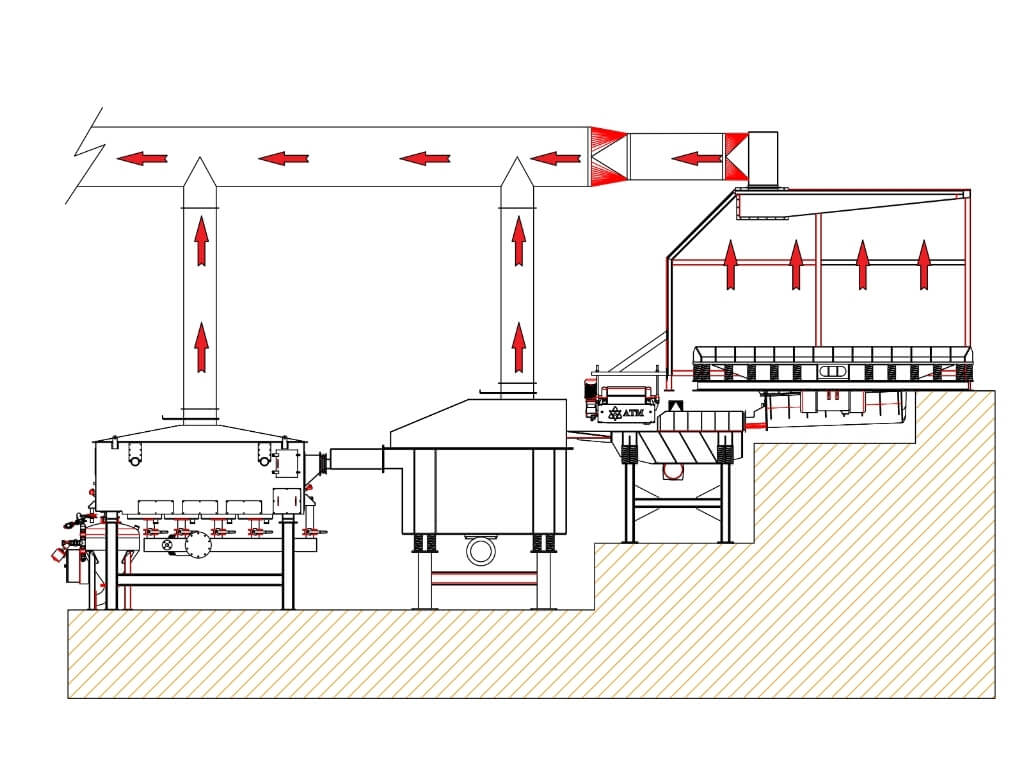
Shakeout


Graded or ungraded molds are placed in the vibratory disintegration zone. Crusher bars made of wear-resistant material are designed to promote efficient and controlled breakdown of the molds.
During the disintegration process, the broken sand agglomerates fall onto the first lower screen. Under vibration, the sand particles rub against each other, further reducing their size.
The sand then passes onto the second screen, where continued particle-to-particle friction brings it to the standard grain size.
The sand passes through the third fine screen located at the rear nose section of the unit and continues through the system. Agglomerated particles larger than the mesh size of the third screen are discharged through the side channels at the rear nose section.
Abrasive Shakeout With High Speed


It is used to separate dust, burnt resins, small metal particles left over from the casting, and small clods left over from the first vibrating shakeout. It helps classify and separate the sand.
Sand Cooler - Classifer Unit


Sand cooler/classifier unit types vary according to capacity requirements and target sand outlet temperature. The units are manufactured with a modular design and consist of an integrated cooling heat exchanger housed within the main body, positioned between the inlet and outlet sections.
Inside the sand cooler, the sand moves in a fluidized bed. Through guidance provided by a series of baffles and partitions, the sand comes into contact with all surfaces of the heat exchanger cooling tubes, ensuring optimal heat transfer from the sand to the cooling water.
The discharge temperature of the sand depends on the ambient temperature as well as the flow rate and inlet temperature of the cooling water. Under typical operating conditions, the sand temperature is reduced to approximately 6°C above the inlet temperature of the water passing through the heat exchanger.
Sand classification within the cooler is achieved by extracting fine particles and dust from the sand using an airflow through the suction hood. The suction hood is equipped with an inspection door and a manometer, and the correct negative pressure must be maintained as indicated by the manometer.
The fine particles extracted from the unit are collected and retained in a filter of appropriate size.
Pneumatic Sand Vator

This unit can be installed beneath a sand silo or at the discharge end of the reclamation system. Sand is admitted into the unit by opening the pneumatic butterfly valve. Operation is controlled by a timer located within the control panel.
Once the unit is filled, it is pressurized, and the sand is conveyed through the pipeline to the designated silo.
After the sand has been discharged, the butterfly valve opens again, and the cycle repeats until a “silo full” signal is received from the high-level probe in the target silo, or until a “no sand available” signal is received from the probe located at the top of the unit. When the sand level in the silo drops below the full level, the cycle automatically restarts.
The unit is equipped with its own locally mounted control panel.